Don’t forget to write

One favorite:
The 10 Letters Project.

I’ve been going through boxes (many many boxes) of old letters written to and by my mom and to my dad, letters from and to my grandparents. The older ones are yellowing and falling apart. Many were composed on that light blue air mail paper you’d fold up and seal so that it became a self-contained letter and envelope in one.

Some of the letters are interesting (descriptions of trips to Europe or the poetic love my grandfather displayed for my grandmother — even long after they were married!) and others are not that interesting. They were probably never meant to be seen, more like the emails you get from a friend telling you the weather is good and they look forward to hanging out again. And yet here they are, fifty plus years later.

There is something inherently interesting about them just because they are letters. I am not the first person to say this and I won’t be the last, but I miss writing letters and I miss receiving them. Sure, they are dated, their contents composed days or even weeks ago, a lag which now feels almost archaic. But even just one sitting in your mailbox between bills and tactile spam is thrilling. Then there’s how a person’s handwriting can be incredibly revealing (a college boyfriend had incredibly calligraphy which is probably why I didn’t burn them when we broke up).
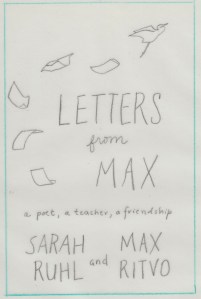
Letters from Max: A beautiful and sad story of a friendship.

On a family trip a few years ago my daughter made friends with a woman in her twenties. The woman lived across the country from us so the two of them agreed to write letters, and they did, for more than a year. Mundane, thrilling letters.

It’s probably not a surprise that I like reading collections of letters, primarily of artists and writers. Chekhov’s are great, as are Van Gogh’s, though one of my absolute favorite book is of the letters of children’s book editor Ursula Nordstrom, especially those to her writers, including E.B. White, Margaret Wise Brown and Maurice Sendak.

Recently though, I’ve been getting into those between not-famous people, friends who are just keeping in touch. There’s a fair amount of weather and much mundane life and it reminds me of my family letters, and those I used to send home from camp, which were spectacularly boring, yet must have meant something because they are also included in those boxes.
Santa Claus and the Internet

When my kids were little, I was self-endowed with great amounts of the sort of wisdom one has when one has never been a parent. I knew exactly how I wanted to raise them, how I mould out of their open and trusting characters thoughtful, creative people who pursued their own goals but did so out of self-knowledge and a sense of justice and fairness. Now they are teenagers and they are really good kids but I still can’t avoid questions about our choices and whether I would do things differently.

Clearly this is somewhat of an obsession; the novel I just finished has this as a central question. How to raise kids when the internet has their own ideas about who they should be?

I wanted my kids to have a childhood, one where they got muddy and collected bugs and created fairy houses out of sticks and moss and acorns. They read books and drew, painted, sewed, knitted and seemed altogether happy. Then they found out about the internet. And they were pissed.

We were able to keep it from them (as if it was a dirty secret)only by sending them to a Waldorf school, and even then apple products oozed in through cracks in the rough-hewn walls. By seventh grade, iPhones were like sex — some kids had them, those without felt cheated; everyone was categorized by whether or not they’d lost their “innocence.”

My kids got phones in high school, which is pretty late by most standards. I don’t understand why anyone would need (as opposed to want) them earlier, but that’s me. They were thrilled of course, but underneath their liberation there was — and continues to be — a sense of righteous fury: All these funny cats and people failing were here all along and you kept them from us! It’s eerily similar to the way my son in particular feels (rightly so!) about Santa Claus, as fraud perpetuated on him for years.

I have second thoughts about the Santa Claus decision; if I could go back we’d probably celebrate Solstice instead and swear them to secrecy around their classmates, but exposure to the internet brings up even more fraught emotions. Not only are they let loose online, but it’s with a complete understanding of my feelings about it’s many problems (yes yes, there is much good there but teenagers do not tend to gravitate to the more enlightening aspects of the online world), which makes their phones a tool of rebellion.

Maybe if I’d just gotten over myself and let them have phones earlier, they could have had a healthier relationship with technology. I have few doubts that it will all settle down — my son will start reading again, my daughter might one day compare what I say to what an influencer says and favor my perspective — but was it worth it for them to have that real world tactile childhood? I do think so, but what do I know?

The Writer and Her/His Thoughts

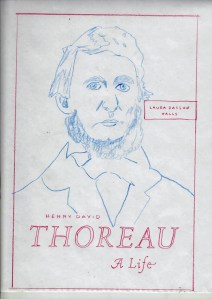
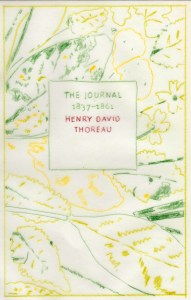
For the last several months, I’ve been doing a deep dive into Thoreau, alternating the Journal with Laura Dassow’s excellent biography. It’s a hefty project, since both are fat books, and now, nearly finished, I might be nothing close to a Thoreau scholar, but I know the man as more than a guy who lived by a pond for awhile.

I am only slightly embarrassed to admit that while baking in Thoreau’s ideas and hijinks (he climbed a tree and caught an owl in his bare hands — and later released it; in order to understand geese better he would sometimes flap his arms and honk like them), I frequently irritated my family with stories (“Did you know that Thoreau’s home was a stop on the Underground Railroad? That he was one of the first and most vocal supporters of John Brown?). My daughter would groan and say “Thoreau — again?” though she’d pronounce it “throw” as if she wanted to throw me across the room.

Reading them both together — I would focus on several years of the journal followed by the corresponding chapter of the biography — has given me an even deeper appreciation of how humble the guy was. His neighbors bemoaned his lack of ambition (one made fun of him for standing by a pond for hours observing frogs), they failed to notice that he was also lecturing, building houses, making crucial observations about levels of the river and its flow, surveying property and, oh yes, writing several books and magazine articles. He did all those things yet there was little mention in his diary, which instead was filled with pages and pages of birds and frogs and meticulous descriptions of plants, all of which sounds very boring, but absolutely was not, as he tied all that observation into the relationship between man and the natural world and to what it means to live a good life.

In my twenties I once tried to tackle John Cheever’s short stories alongside his journals. I was far too young and narcissistic to understand the struggles of an older man. Now might be the time to go back to it, though my interests have changed and I’m more attuned to the world of a nineteenth century nature lover than a twentieth century suburban writer, no matter how brilliant his stories.

Still, I might give it a shot. Along with Dawn Powell, Katherine Mansfield, Virginia Woolf….a new reading project.

Forever Young

A year into my self-directed immersion course on Thoreau, I still find, almost daily, some observation or thought that resonates. Many I wish I’d read (and actually heeded — two different things) in my twenties. Like all of us, he is trying to find out how to be in the world. He points out that the “real jobs” held by neighbors would drive him bananas, and despite days filled with hard work and observation he is constantly fighting off accusations (often from friends like Emerson) that he is lazy. Take it from me, lying on the couch on a sunny cold afternoon, he was nothing close to lazy.

He worked in the pencil factory, he helped neighbors raise houses, he kept this incredibly meticulous journal filled with scientific observations, he wrote many books, he lectured on many things, including abolition, his house was a stop on the Underground Railroad. And, one of my favorite things about him, he played. Constantly. In some ways like a kid. He would ice skate for hours at a time, he climbed trees (well into his 30s). In one tree, he caught an owl in his bare hands (and later let it go), he found dragged snapping turtles home (at great risk to his fingers and toes) to observe them and dug up turtle eggs then buried them outside his house so he would watch them hatch.

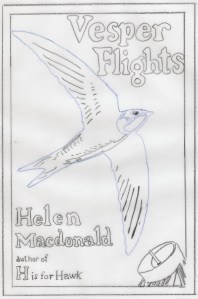
Having read a number of books written by great observers of the natural world, I’ve noticed many have this sense of almost childlike wonder and adventure in common. In Vesper Flights, Helen MacDonald finds meaning in birds and trees and takes cues from the natural world on how to live. she talks about hunting for mushrooms:

“Searching for chanterelles, I’ve found myself unconsciously walking on tiptoe across mossy stumps, as if they might hear me coming. It doesn’t work well if you walk around and try to spot them directly. They have an uncanny ability to hide from the searching eye. Instead, you have to alter the way you regard the ground around you, concern yourself with the strange phenomenology of leaf litter and try to give equal attention to all colors, shapes and angles on the messy forest floor.” 

Vesper Flights

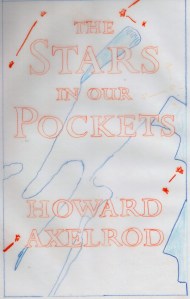
In his book, The Stars in Our Pockets, Howard Axelrod says, “Attention span isn’t a matter of willpower, or even necessarily of intellect. Attention span comes from curiosity” and goes on to praise the sort of curiosity that “carries you branch to branch.”

I don’t know why it surprised me so much to think about Thoreau climbing trees or skating on the frozen rivers. Maybe I think of him, and everyone from that time period, as sort of old and fusty and missing a sense of whimsy. So it’s strange to think that this is something he could actually teach those of us who are too preoccupied to find some joy in shimmying up a tree and observing a turtle.

The Weekend of the Woman

As in writing there are planners (who outline an entire project by starting) and ‘panthers’ (who write and see where it takes them), there are equivalents when it comes to creative consumption. I tend to be a planner, to have a stack of books I will read next and movies I plan to watch this weekend. For me, it eliminates the stress of staring at a wall of books (or a Netflix queue of movies). Last weekend though, I went crazy and picked movies at random. Both turned out to be great choices and, interestingly, they were an excellent double feature.

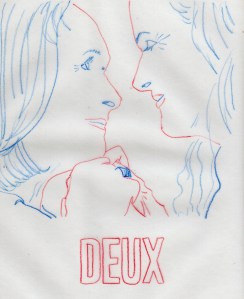
Interestingly, both movies were European. The first was a French movie called Deux (The Two of Us in English). It’s beautiful and heartbreaking, the story of two older women who’ve been in love for years, and are on the verge of going away together. All they have to do is inform the children of one of the characters.

Love between two women, as portrayed in film seems to be mostly be between younger women, either a sexual awakening or as an exploratory effort towards self-discovery. This was quotidian, real life love. The first film of director Filippo Meneghetti, it could easily have become melodramatic, but instead it is quietly moving.

Although I have the equivalent of a bedside stack of movies on my to-be-watched list, I only watch one or two a week, as I prefer reading and, though I know I could do both, I am more impatient with movies than books. My husband is the opposite — an occasional reader. He and I argue (good-naturedly) about it. He claims he can watch ten movies in the time it takes me to read a book, which is true. But I counter by saying that when I love a book (or a movie) I want to live in it for awhile. A movie boots me out after a few hours.

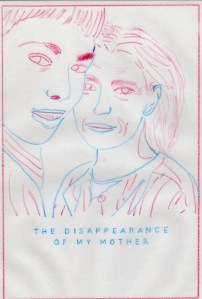
The second movie was an Italian documentary about the 60s supermodel Benedetta who became a radical feminist in the 70s. Her career, and her resistance to being considered a “stupid model,” are interesting but like good documentaries, there are so many layers. Underneath the glamour of the young Benedetta and the incredible poise of Benedetta today, is a son, the film maker, trying to get to know his mother. He follows her everywhere, films her sleeping and getting dressed. He hires models to reenact her iconic Vogue covers and to read from her diary.

She, who says multiple times how much she hates images, how much images lie, yells at him repeatedly but he persists. Clearly, he is obsessed with her and it makes for incredibly intimate, occasionally uncomfortable but completely engrossing movie.

Reading Blind: A Test Case

When reading a book — any book (or by that means any printed matter) — I am by nature someone who devours the inner and outer flap, the blurbs, and the author bio fifteen times, sometimes interrupting a chapter to flip back and see if the author really has three kids and dedicated the book to her pet guinea pig. It’s a tic and a horrible habit which not only yanks me out of the story, it pulls me towards opinions that have nothing to do with my experience with the book (ie. “Oh right, The NYT loved it” or “Ooh, so the back says the protagonist is going to get lost…” or “I wonder if she and her Brooklyn-living family live in a brownstone or one of those converted lofts”).

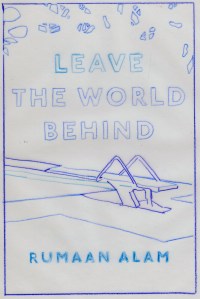
One of the many vague floating reading resolutions I made this year was to do my best to knock it off. Read the damn book. My test case was the contemporary novel, Leave the World Behind, by Rumaan Alam. I didn’t read the reviews; my husband read it but I forbade him to utter a syllable until I was finished, I removed and hid the dust jacket. I even switched off a radio interview before the introductions were completed.

And I’m so glad I did because the whole thing was a huge surprise. When (white) Amanda and Clay and their kids are interrupted on their Long Island vacation home on the second night by the (Black) owners of the rental house, I did not know what was in store. Would there be a fight? Would the police be involved? Would the Proud Boys show up? What sort of book was this? In order not to ruin someone else’s experience, I am not going to answer that. I will say that it hooked me. The writing is vivid and skillful and I’m always game for poking fun at Brooklynites.

There were several things I didn’t like about the book. Primarily, I didn’t care about the characters…not because they were smug and consumerist, since smug and consumerist people are people too, or that I didn’t like them, since I’m a sucker for an unlikeable character, but that they were flat. I didn’t understand what made them operate. And because the plot was so compelling, I didn’t care. I noticed, but it wasn’t until I was done and could think about the whole package that it bothered me.

In retrospect, is that a good thing? Will I become a slave to plot and ignore other important ingredients of a story? Maybe, but there is also the idea that it’s more fair to the author, giving the story a chance to have its say before the greek chorus kicks in.

Well-Scripted

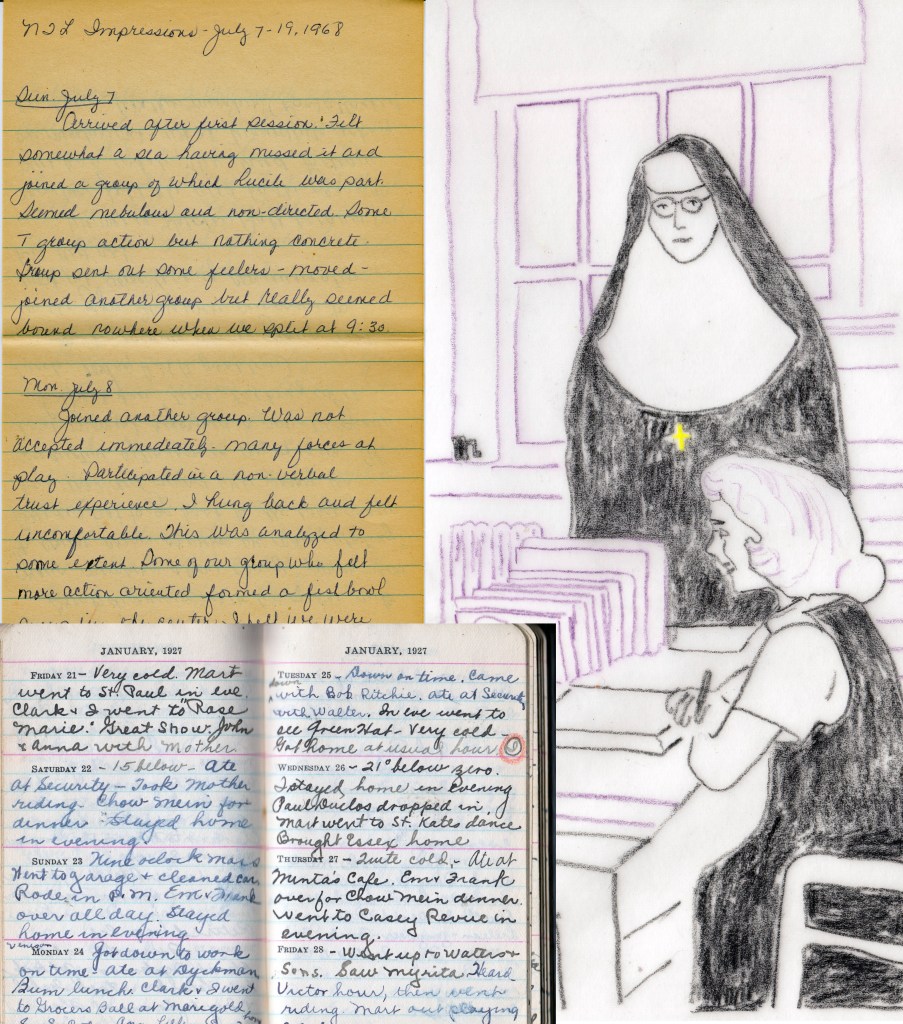
As the designated family packrat, I have accumulated boxes and crates and mouse-eaten folders of written records handed down through the generations. I have the letters my grandfather wrote to woo my grandmother, I have the scrapbooks my grandparents kept on their months-long trips through Europe (before photography was so cheap and easy, their books consisted mostly of menus and matchbooks and itineraries). I have dozens and dozens of my mom’s daily journals. 

And I mean “daily.” Every single day, without fail, she wrote down what she did. Who she had lunch with, who called, who wrote, what happened in the news. She was a master data recorder, and they were quite full because the woman did not sit still. She was always going to a meeting or having lunch or “dropping in” somewhere (SO unlike me, who writes every engagement in huge red letters because, even pre-covid, I have always been a homebody). 

Years ago, I remember looking through some of these documents with my mom and mistaking her my grandmother’s daily diary for my mom’s (my grandmother was also a busy woman). “But that’s your handwriting!” I said. We compared hers and my grandmother’s side by side and it was exactly the same. 

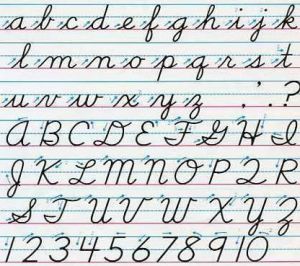
It was the nuns, she said. Raised Roman Catholic, they both were educated by nuns who were extremely strict about cursive writing. Apparently it had to be perfect, or you’d get the ruler on the knuckles treatment. So I imagine classes and classes of young women, their handwriting all exactly the same. I don’t know whether to be depressed by the uniformity of it or impressed at how they valued writing by hand.

Given all the evidence for how good writing by hand is for the brain, how it helps learn language and make connections, it’s hard to believe that most public schools don’t teach cursive anymore. My kids went to a Waldorf school in the early years, where there was almost (but not quite!) a nun-like dedication to handwriting. As a result, both have beautiful handwriting (and are often told so by their public school teachers).

My grandfather, I should say, was absolutely not educated by nuns. His cursive is atrocious. He was a phenomenal writer (he worked for the Minneapolis paper and later in PR), but it takes me hours to decipher one letter. He later started composing his letters on a typewriter to save the receiver the agony of working out the sentences. I wonder what the nuns would have thought of that. 

Lit Meds

Over the past year I’ve wavered between relief and a sense of survivor’s guilt that COVID has not wreaked havoc in my life. Of course it’s been wrenching to read about so much death and illness and general suffering, but other than my kids being cranky and a bit gloomy and taking over the kitchen like marauding colonizers, everything has been okay. At least I thought.

Then I took a closer look at the books I’ve been reading. I’ve always been a fairly instinctual reader. I drift towards what feels right at the time (unless I’m swept up in the hype over a new book, something I try hard to avoid). Apparently what feels right at this time has been a stack of soothing philosophical books and appreciations of nature and the simple life.

All have been great reads — each snuck up on me with its own slice of wisdom or guidance or appropriate escapism. Here are a few samples:

“Maybe this was what I should have said to the boys: How do you find your own way of looking at things? How do you take off your socially preapproved glasses, so that in every glance at the world around you, you feel a part of the world around you, even saved by your sense of belonging in it — a belonging rooted not in your wearing the same glasses as everyone else, but precisely in having taken them off, in feeling your common solitariness with everyone?” 

“What I want us to protect isn’t just the distinctive range of consciousness within each of us but also the ability to share that distinctiveness with each other. That’s the only way I’ve found to feel less alone. That’s the deepest way to look at the stars together. To recognize how fundamentally alone each of us is, locked in a separate body and a separate mind, and in that recognition to have the chance to feel all that reaches across that space between us, all the earth-deep connections that are real.” 

“Watching the flock has brought  home to me how easy it is to react to the idea of masses of refugees with the same visceral apprehension with which we greet a cloud of moving starlings or tumbling geese, to view it as a singular entity, strange and uncontrollable and chaotic. But the crowds coming over the border are people just like us. Perhaps too much like us. We do not want to imagine what it would be to have our familiar places reduced to ruins. In the face of fear, we are all starlings, a group, a flock, made of a million souls seeking safety.” 

“I’ve valued deer for their capacity to surprise and delight me, which is why I’ve resisted learning more about them. The more you know about something, the less it can surprise you. But it’s hard to feel sympathy with a thing whose reality you have chosen to ignore, which makes my attitude not so different from those who would write approvingly of the physics of a dying deer, or how the best thing about a deer collision is how funny it can be.” 

“Science showed him how to see the Cosmos in a grain of sand or the ocean in a woodland pond, a mountain range in Fairhaven Cliff, a glacier in the cobblestones of Walden Pond. Poetry gave him a voice to show the world why this mattered.”

“It takes a man of genius to travel in his own country — in his native village.”

“Hence, emancipation must begin with self-examination: ‘What a man thinks of himself, that it is which determines, or rather indicates, his fate.’ Or, as Saint Augustine wrote in his Confessions: ‘I was held back not be the fetters put on me by someone else, but by the iron bondage of my own will.'”

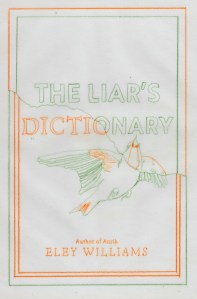
The Liar’s Dictionary

I can’t remember the last time I got swept up by a novel’s exuberance….actually, I can. Eley Williams reminds me of Ali Smith in her sheer adoration of words and willingness to follow a sentence wherever it wants to go.

I first heard her/about her on Backlisted, by far my favorite podcast for where can you hear wildly smart and funny Brits talk about old books and their authors as if they were shiny new. Williams was on a episode about The Victorian Chaise-longue, a short novel by Marghanita Laski. They mentioned The Liar’s Dictionary and I immediately ordered it on Alibris. The day it arrived, it was reviewed in the New York Times, which is always a bit of a downer when you think you’ve discovered something.

It is a book to read for the language, not the plot, but isn’t that why you read a book? A sample:

“The idiom Weasel words apparently comes from the folklore that weasels are able to slurp the contents of an egg while leaving the shell intact. Teaching your weasel how to suck eggs. Weasel words are phrases designed to sound authoritative or meaningful when they lack content or meaning.”

Two Views of Mrs. Thatcher

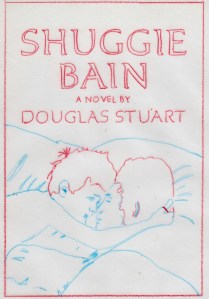
Recently, I caught up with the latest season of The Crown while simultaneously reading Shuggie Bain. Both are excellent and each gives a different perspective (obviously!) on Margaret Thatcher and her deeply reviled economic austerity. In The Crown, as played by Gillian Anderson (whose stiff voice and crooked, purse-slung arm will forever be my vision the Prime Minister), Thatcher is tough but human, a woman interloper in a man’s world. She was, amazingly, sympathetic.

Thatcher never appears directly in Shuggie Bain, but Thatcherism is omnipresent, as it must have been throughout England during that time period. The poverty, the alcoholism, the despair, the crappy housing projects. As she would have said, people need to pull themselves up by their bootstraps. But what if you have no boots?

This is an excellent book to read if you want that bootless experience. The poverty and the despair is palpable — the characters are so well-drawn, the details so immediate — but there is a lightness to the prose. Also, in a book like this it’s so easy to create victims and villains. Douglas Stuart doesn’t do that. Even Shuggie’s father, Shug, is three dimensional and almost sympathetic. Though maybe not in one of my favorite quotes from the book:

“Shug picked up his money belt and kissed her with a forceful tongue. He had to squeeze all the small bones in her hands to get her to release him. She had loved him, and he had needed to break her completely to leave her for good. Agnes Bain was too rare a thing to let someone else love. It wouldn’t do to leave pieces of her for another man to collect and repair later.”