The Writer and Her/His Thoughts

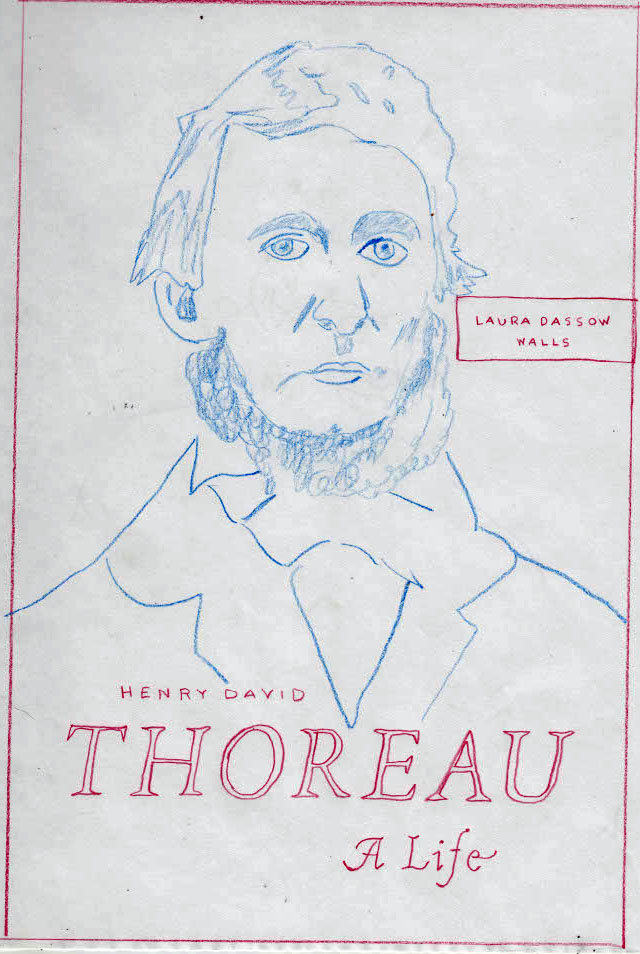
For the last several months, I’ve been doing a deep dive into Thoreau, alternating the Journal with Laura Dassow’s excellent biography. It’s a hefty project, since both are fat books, and now, nearly finished, I might be nothing close to a Thoreau scholar, but I know the man as more than a guy who lived by a pond for awhile.

I am only slightly embarrassed to admit that while baking in Thoreau’s ideas and hijinks (he climbed a tree and caught an owl in his bare hands — and later released it; in order to understand geese better he would sometimes flap his arms and honk like them), I frequently irritated my family with stories (“Did you know that Thoreau’s home was a stop on the Underground Railroad? That he was one of the first and most vocal supporters of John Brown?). My daughter would groan and say “Thoreau — again?” though she’d pronounce it “throw” as if she wanted to throw me across the room.
Reading them both together — I would focus on several years of the journal followed by the corresponding chapter of the biography — has given me an even deeper appreciation of how humble the guy was. His neighbors bemoaned his lack of ambition (one made fun of him for standing by a pond for hours observing frogs), they failed to notice that he was also lecturing, building houses, making crucial observations about levels of the river and its flow, surveying property and, oh yes, writing several books and magazine articles. He did all those things yet there was little mention in his diary, which instead was filled with pages and pages of birds and frogs and meticulous descriptions of plants, all of which sounds very boring, but absolutely was not, as he tied all that observation into the relationship between man and the natural world and to what it means to live a good life.

In my twenties I once tried to tackle John Cheever’s short stories alongside his journals. I was far too young and narcissistic to understand the struggles of an older man. Now might be the time to go back to it, though my interests have changed and I’m more attuned to the world of a nineteenth century nature lover than a twentieth century suburban writer, no matter how brilliant his stories.

Still, I might give it a shot. Along with Dawn Powell, Katherine Mansfield, Virginia Woolf….a new reading project.
Forever Young

A year into my self-directed immersion course on Thoreau, I still find, almost daily, some observation or thought that resonates. Many I wish I’d read (and actually heeded — two different things) in my twenties. Like all of us, he is trying to find out how to be in the world. He points out that the “real jobs” held by neighbors would drive him bananas, and despite days filled with hard work and observation he is constantly fighting off accusations (often from friends like Emerson) that he is lazy. Take it from me, lying on the couch on a sunny cold afternoon, he was nothing close to lazy.

He worked in the pencil factory, he helped neighbors raise houses, he kept this incredibly meticulous journal filled with scientific observations, he wrote many books, he lectured on many things, including abolition, his house was a stop on the Underground Railroad. And, one of my favorite things about him, he played. Constantly. In some ways like a kid. He would ice skate for hours at a time, he climbed trees (well into his 30s). In one tree, he caught an owl in his bare hands (and later let it go), he found dragged snapping turtles home (at great risk to his fingers and toes) to observe them and dug up turtle eggs then buried them outside his house so he would watch them hatch.

Having read a number of books written by great observers of the natural world, I’ve noticed many have this sense of almost childlike wonder and adventure in common. In Vesper Flights, Helen MacDonald finds meaning in birds and trees and takes cues from the natural world on how to live. she talks about hunting for mushrooms:

“Searching for chanterelles, I’ve found myself unconsciously walking on tiptoe across mossy stumps, as if they might hear me coming. It doesn’t work well if you walk around and try to spot them directly. They have an uncanny ability to hide from the searching eye. Instead, you have to alter the way you regard the ground around you, concern yourself with the strange phenomenology of leaf litter and try to give equal attention to all colors, shapes and angles on the messy forest floor.” 

Vesper Flights

In his book, The Stars in Our Pockets, Howard Axelrod says, “Attention span isn’t a matter of willpower, or even necessarily of intellect. Attention span comes from curiosity” and goes on to praise the sort of curiosity that “carries you branch to branch.”

I don’t know why it surprised me so much to think about Thoreau climbing trees or skating on the frozen rivers. Maybe I think of him, and everyone from that time period, as sort of old and fusty and missing a sense of whimsy. So it’s strange to think that this is something he could actually teach those of us who are too preoccupied to find some joy in shimmying up a tree and observing a turtle.

Well-Scripted

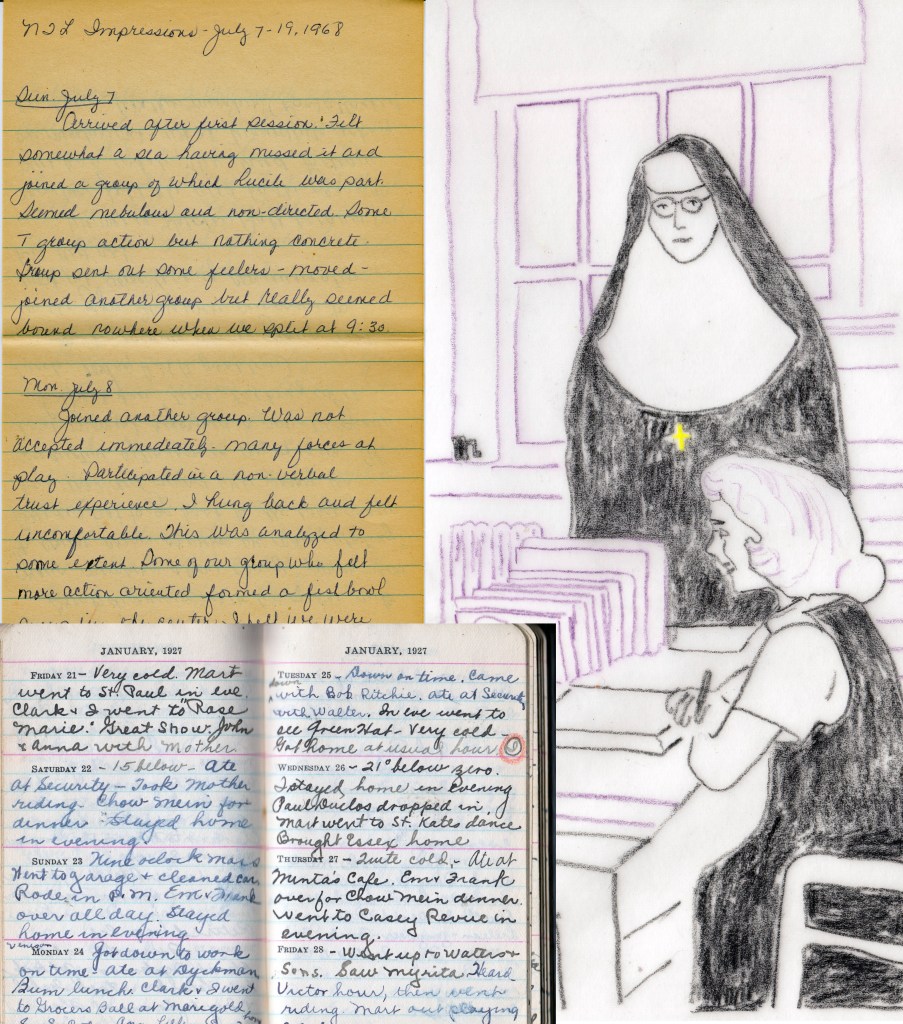
As the designated family packrat, I have accumulated boxes and crates and mouse-eaten folders of written records handed down through the generations. I have the letters my grandfather wrote to woo my grandmother, I have the scrapbooks my grandparents kept on their months-long trips through Europe (before photography was so cheap and easy, their books consisted mostly of menus and matchbooks and itineraries). I have dozens and dozens of my mom’s daily journals. 

And I mean “daily.” Every single day, without fail, she wrote down what she did. Who she had lunch with, who called, who wrote, what happened in the news. She was a master data recorder, and they were quite full because the woman did not sit still. She was always going to a meeting or having lunch or “dropping in” somewhere (SO unlike me, who writes every engagement in huge red letters because, even pre-covid, I have always been a homebody). 

Years ago, I remember looking through some of these documents with my mom and mistaking her my grandmother’s daily diary for my mom’s (my grandmother was also a busy woman). “But that’s your handwriting!” I said. We compared hers and my grandmother’s side by side and it was exactly the same. 

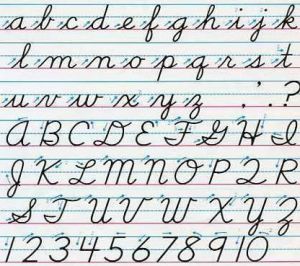
It was the nuns, she said. Raised Roman Catholic, they both were educated by nuns who were extremely strict about cursive writing. Apparently it had to be perfect, or you’d get the ruler on the knuckles treatment. So I imagine classes and classes of young women, their handwriting all exactly the same. I don’t know whether to be depressed by the uniformity of it or impressed at how they valued writing by hand.

Given all the evidence for how good writing by hand is for the brain, how it helps learn language and make connections, it’s hard to believe that most public schools don’t teach cursive anymore. My kids went to a Waldorf school in the early years, where there was almost (but not quite!) a nun-like dedication to handwriting. As a result, both have beautiful handwriting (and are often told so by their public school teachers).

My grandfather, I should say, was absolutely not educated by nuns. His cursive is atrocious. He was a phenomenal writer (he worked for the Minneapolis paper and later in PR), but it takes me hours to decipher one letter. He later started composing his letters on a typewriter to save the receiver the agony of working out the sentences. I wonder what the nuns would have thought of that. 

Thoreau and Character

The angle intersections inscribed by our daily experiences, the coves and inlets of our lives, will ground the decisions we make, our actions in the world. And the sum total of all our moral actions combined will constitute the ethical character of the society we build together.

Hopping back and forth between Thoreau’s (excellent) biography and his journals is an education not just in the life of a decidedly quirky man, but also the rapid and disturbing settlement of the country. When he first discovered the pond it was wild and largely isolated; by the time he built his cabin, the train was passing by and there were settlements left behind by the Irish workers who built worked on the railroads. Surprisingly though, despite his deep connection with nature (rumor had it he befriended crows and squirrels and could summon a woodchuck by whistling), he was not opposed to development if it furthered the human condition.