Fictional Simplicity

I would love to conduct a scientific experiment in which one version of my brain read contemporary fiction while another read an old classic, a Jane Austen novel for example, and I could sit back and compare their experiences.

I’m about halfway through Gary Shteyngart’s fantastically funny beautifully written new novel, Our Country Friends. It is entertaining and theoretically immersive and yet I can’t seem to read more than a chapter or two without drifting…(did I pay my credit card bill? I forgot to sign my kid’s sports consent form! Is it cold in here?). Not that this isn’t a fairly common experience in my life, but here’s the strange thing: Last month I re-read Mansfield Park and I sunk into it like a warm bath and came out only when I was relaxed and slightly shriveled.

So I’m wondering if there is a connection. Not in the prose so much as the world it portrays. Shteyngart’s novel is literally of the moment, full of phones, Covid, helicopter parenting and ambitious neurotic people. In Austen, a long walk could be the highlight of the day. News arrives so sporadically that each new snippet can be chewed over for days before the next one arrives.

Think of all the things we need to remember today: Passwords, who to call when the heat doesn’t work. Is it oil? Propane? How to unclog a drain, pay bills, pay taxes. Directions to the dentist, all the various doctor appointments and what your health care plan will cover. Which former republic is Russia planning to invade? What horrible things are the Chinese government doing now, without repercussions? That’s without touching on the latest music, movies, tv shows and whether or not I even subscribe to the service which will allow me to watch them.

Maybe it’s age catching up with me, this desire to downscale the input. My brain is fed up and its way of telling me is to cut me off after a chapter of the latest fiction. It’s telling me that I really should be living in a time when I could spend an entire morning hand-washing the underwear I’ve probably been wearing for days at a time. Gross? Yes. But so much less stressful!
My Life in Poetry

Lately, in an effort to not think about politics and the state of things, at least in the morning, I’ve taken to listening to the poetry podcast, The Slowdown, hosted by Ada Limon. It’s not a new show — for awhile it was hosted by Tracy K. Smith — but for whatever reason it has recently pulled me in to the point where it is nearly as essential as coffee.

The format is simple: Ada Limon picks a poem and introduces it with a short essay. The poems are invariably great, but it is the essays that pull me in and I am always a little (embarrassingly) disappointed when she shifts from talking to reciting. It got me thinking about poetry in my life. I want to love it much more than I actually do. I have shelves of books from Wordsworth to Rilke to Adrienne Rich to Billy Collins to Ada Limon and Tracy K. Smith. I read it often, but it does not seep into my bones the way I want it to. My mind wanders. Maybe I’m just too impatient, always looking for plot. I assumed I was always that way.

Recently though, I found a box of books from my childhood home. There was some James Michener, some Vonnegut, a stack of books from my high school class on dystopian literature which now seems quite relevant. There was also a lot of poetry. And here’s the thing: the books were dog-eared, underlined; there were notes in the margins and stars next to the titles I loved best. I had circled words I loved.

What happened? It is as if poetry was a youthful dalliance and now we broke up, or at least settled into a more cordial relationship. I’ve grown out of a lot of bad habits — thumb-sucking, using pretentious words in an effort to impress people, collecting baseball hats. Did I grow out of poetry?

I can only hope that I somehow cycle back to it. That someday soon I crave it again, a craving more along the lines of sweets than the vegetables my body knows are good for it.

How Yiyun Li Snuck Up on Me

I’ve been reading Yiyun Li’s stories in The New Yorker for years. I often listen to them, read by the author in her sweet, soft voice. And I’ve always liked them well enough.

Then, in the early days of the pandemic, when I sat on the front porch with a broken ankle and nowhere to go, nothing to do, I decided to join her Tolstoy Together deep dive into War and Peace. I had never particularly aspired to read War and Peace; of the Russians, I was more partial to Chekhov. But wow. Following her daily suggested allotment, enchanted by her comments and her enthusiasm, I not only read the whole thing, I devoured it. Two packages of color-coded post-its now adorn the pages.

The experience was so joyful that I began to read Yiyun Li’s work more attentively. I look forward to her New Yorker stories and when one shows up, like this week, it’s like biblio-Christmas.

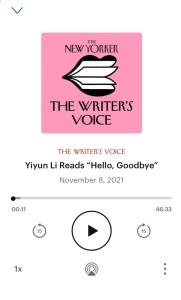
“Hello, Goodbye” is a particularly good one. It has an Alice Munro flavor to it, of a long span of time compressed, of entire lives lived in the span of a few pages. When I read and fall in love with these stories, a part of me hopes that they are excerpts from novels. The other part is so happy to have spent time admiring all the facets of this little jewel.

Reading Blind: A Test Case

When reading a book — any book (or by that means any printed matter) — I am by nature someone who devours the inner and outer flap, the blurbs, and the author bio fifteen times, sometimes interrupting a chapter to flip back and see if the author really has three kids and dedicated the book to her pet guinea pig. It’s a tic and a horrible habit which not only yanks me out of the story, it pulls me towards opinions that have nothing to do with my experience with the book (ie. “Oh right, The NYT loved it” or “Ooh, so the back says the protagonist is going to get lost…” or “I wonder if she and her Brooklyn-living family live in a brownstone or one of those converted lofts”).

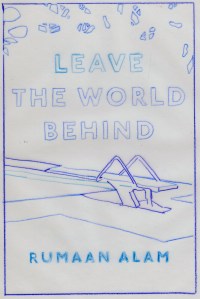
One of the many vague floating reading resolutions I made this year was to do my best to knock it off. Read the damn book. My test case was the contemporary novel, Leave the World Behind, by Rumaan Alam. I didn’t read the reviews; my husband read it but I forbade him to utter a syllable until I was finished, I removed and hid the dust jacket. I even switched off a radio interview before the introductions were completed.

And I’m so glad I did because the whole thing was a huge surprise. When (white) Amanda and Clay and their kids are interrupted on their Long Island vacation home on the second night by the (Black) owners of the rental house, I did not know what was in store. Would there be a fight? Would the police be involved? Would the Proud Boys show up? What sort of book was this? In order not to ruin someone else’s experience, I am not going to answer that. I will say that it hooked me. The writing is vivid and skillful and I’m always game for poking fun at Brooklynites.

There were several things I didn’t like about the book. Primarily, I didn’t care about the characters…not because they were smug and consumerist, since smug and consumerist people are people too, or that I didn’t like them, since I’m a sucker for an unlikeable character, but that they were flat. I didn’t understand what made them operate. And because the plot was so compelling, I didn’t care. I noticed, but it wasn’t until I was done and could think about the whole package that it bothered me.

In retrospect, is that a good thing? Will I become a slave to plot and ignore other important ingredients of a story? Maybe, but there is also the idea that it’s more fair to the author, giving the story a chance to have its say before the greek chorus kicks in.

Lit Meds

Over the past year I’ve wavered between relief and a sense of survivor’s guilt that COVID has not wreaked havoc in my life. Of course it’s been wrenching to read about so much death and illness and general suffering, but other than my kids being cranky and a bit gloomy and taking over the kitchen like marauding colonizers, everything has been okay. At least I thought.

Then I took a closer look at the books I’ve been reading. I’ve always been a fairly instinctual reader. I drift towards what feels right at the time (unless I’m swept up in the hype over a new book, something I try hard to avoid). Apparently what feels right at this time has been a stack of soothing philosophical books and appreciations of nature and the simple life.

All have been great reads — each snuck up on me with its own slice of wisdom or guidance or appropriate escapism. Here are a few samples:

“Maybe this was what I should have said to the boys: How do you find your own way of looking at things? How do you take off your socially preapproved glasses, so that in every glance at the world around you, you feel a part of the world around you, even saved by your sense of belonging in it — a belonging rooted not in your wearing the same glasses as everyone else, but precisely in having taken them off, in feeling your common solitariness with everyone?” 

“What I want us to protect isn’t just the distinctive range of consciousness within each of us but also the ability to share that distinctiveness with each other. That’s the only way I’ve found to feel less alone. That’s the deepest way to look at the stars together. To recognize how fundamentally alone each of us is, locked in a separate body and a separate mind, and in that recognition to have the chance to feel all that reaches across that space between us, all the earth-deep connections that are real.” 

“Watching the flock has brought  home to me how easy it is to react to the idea of masses of refugees with the same visceral apprehension with which we greet a cloud of moving starlings or tumbling geese, to view it as a singular entity, strange and uncontrollable and chaotic. But the crowds coming over the border are people just like us. Perhaps too much like us. We do not want to imagine what it would be to have our familiar places reduced to ruins. In the face of fear, we are all starlings, a group, a flock, made of a million souls seeking safety.” 

“I’ve valued deer for their capacity to surprise and delight me, which is why I’ve resisted learning more about them. The more you know about something, the less it can surprise you. But it’s hard to feel sympathy with a thing whose reality you have chosen to ignore, which makes my attitude not so different from those who would write approvingly of the physics of a dying deer, or how the best thing about a deer collision is how funny it can be.” 

“Science showed him how to see the Cosmos in a grain of sand or the ocean in a woodland pond, a mountain range in Fairhaven Cliff, a glacier in the cobblestones of Walden Pond. Poetry gave him a voice to show the world why this mattered.”

“It takes a man of genius to travel in his own country — in his native village.”

“Hence, emancipation must begin with self-examination: ‘What a man thinks of himself, that it is which determines, or rather indicates, his fate.’ Or, as Saint Augustine wrote in his Confessions: ‘I was held back not be the fetters put on me by someone else, but by the iron bondage of my own will.'”

The Liar’s Dictionary

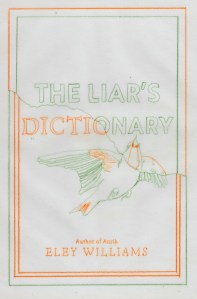
I can’t remember the last time I got swept up by a novel’s exuberance….actually, I can. Eley Williams reminds me of Ali Smith in her sheer adoration of words and willingness to follow a sentence wherever it wants to go.

I first heard her/about her on Backlisted, by far my favorite podcast for where can you hear wildly smart and funny Brits talk about old books and their authors as if they were shiny new. Williams was on a episode about The Victorian Chaise-longue, a short novel by Marghanita Laski. They mentioned The Liar’s Dictionary and I immediately ordered it on Alibris. The day it arrived, it was reviewed in the New York Times, which is always a bit of a downer when you think you’ve discovered something.

It is a book to read for the language, not the plot, but isn’t that why you read a book? A sample:

“The idiom Weasel words apparently comes from the folklore that weasels are able to slurp the contents of an egg while leaving the shell intact. Teaching your weasel how to suck eggs. Weasel words are phrases designed to sound authoritative or meaningful when they lack content or meaning.”

Two Views of Mrs. Thatcher

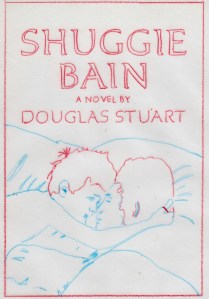
Recently, I caught up with the latest season of The Crown while simultaneously reading Shuggie Bain. Both are excellent and each gives a different perspective (obviously!) on Margaret Thatcher and her deeply reviled economic austerity. In The Crown, as played by Gillian Anderson (whose stiff voice and crooked, purse-slung arm will forever be my vision the Prime Minister), Thatcher is tough but human, a woman interloper in a man’s world. She was, amazingly, sympathetic.

Thatcher never appears directly in Shuggie Bain, but Thatcherism is omnipresent, as it must have been throughout England during that time period. The poverty, the alcoholism, the despair, the crappy housing projects. As she would have said, people need to pull themselves up by their bootstraps. But what if you have no boots?

This is an excellent book to read if you want that bootless experience. The poverty and the despair is palpable — the characters are so well-drawn, the details so immediate — but there is a lightness to the prose. Also, in a book like this it’s so easy to create victims and villains. Douglas Stuart doesn’t do that. Even Shuggie’s father, Shug, is three dimensional and almost sympathetic. Though maybe not in one of my favorite quotes from the book:

“Shug picked up his money belt and kissed her with a forceful tongue. He had to squeeze all the small bones in her hands to get her to release him. She had loved him, and he had needed to break her completely to leave her for good. Agnes Bain was too rare a thing to let someone else love. It wouldn’t do to leave pieces of her for another man to collect and repair later.” 

Thoreau and Character

The angle intersections inscribed by our daily experiences, the coves and inlets of our lives, will ground the decisions we make, our actions in the world. And the sum total of all our moral actions combined will constitute the ethical character of the society we build together.

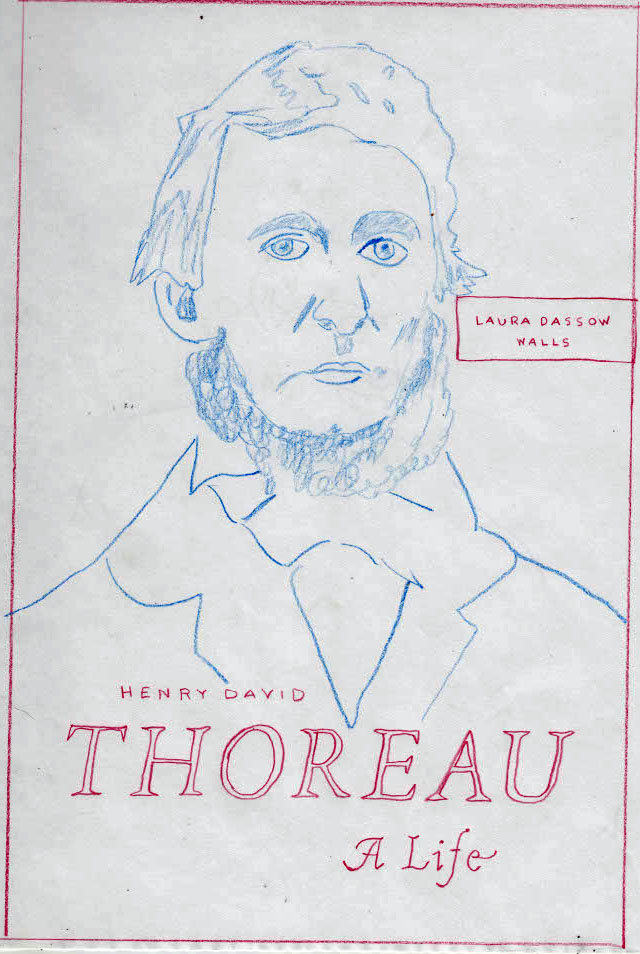
Hopping back and forth between Thoreau’s (excellent) biography and his journals is an education not just in the life of a decidedly quirky man, but also the rapid and disturbing settlement of the country. When he first discovered the pond it was wild and largely isolated; by the time he built his cabin, the train was passing by and there were settlements left behind by the Irish workers who built worked on the railroads. Surprisingly though, despite his deep connection with nature (rumor had it he befriended crows and squirrels and could summon a woodchuck by whistling), he was not opposed to development if it furthered the human condition.

Information Glut

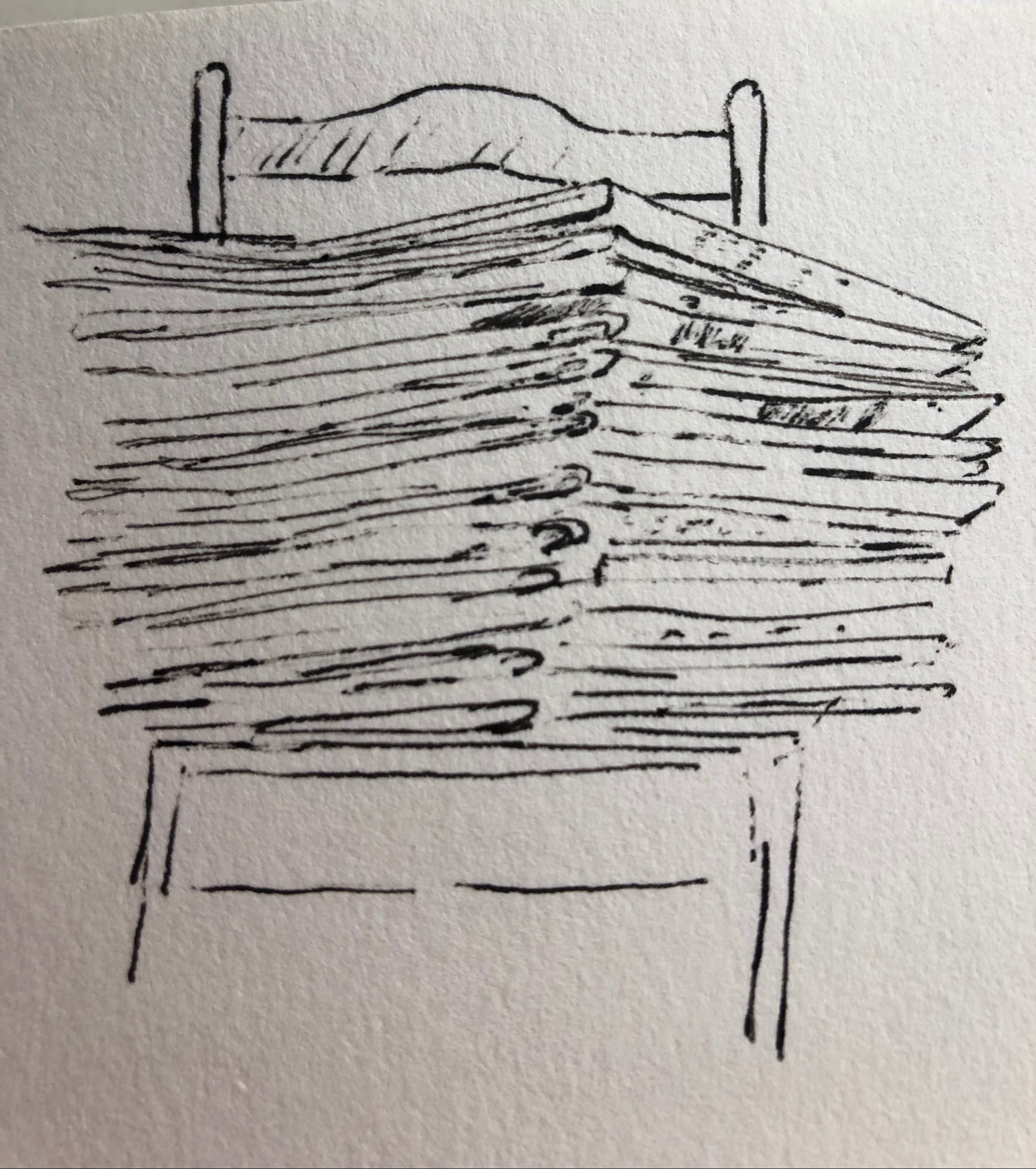
image_571255852034517I grew up in a beautiful house furnished by books and stacks and stacks and stacks…of periodicals. Newspapers, magazines, brochures and catalogues were stacked on chairs and tables. This was the decor of my mom, an information hoarder who could not stand to let a single article in The Minneapolis Star Tribune, The New York Times, Time, Newsweek, The New Yorker, The Economist…go unread.
I loved this in her, even as the clutter drove me crazy and I vowed my house would be free of any pile thicker then at the width of my hand.

Then came the internet. And Evernote. I am a compulsive clipper. I have digital notebooks which, if converted, could paper the chairs of a giant suburban neighborhood.

Why? What am I going to do with this information? Read it? I am convinced there’s a hole in my brain through which 90% of what I read passes within ten minutes. Still, I persist. I suppose some inherited traits are unexpected.

Day after day after day after…

When you take a step back and think about time as a concept, it’s pretty bizarre. Maybe not so much time as the way we categorize it and feel as if we’ve got a hold of it by chopping it up into manageable pieces (days, months, years).

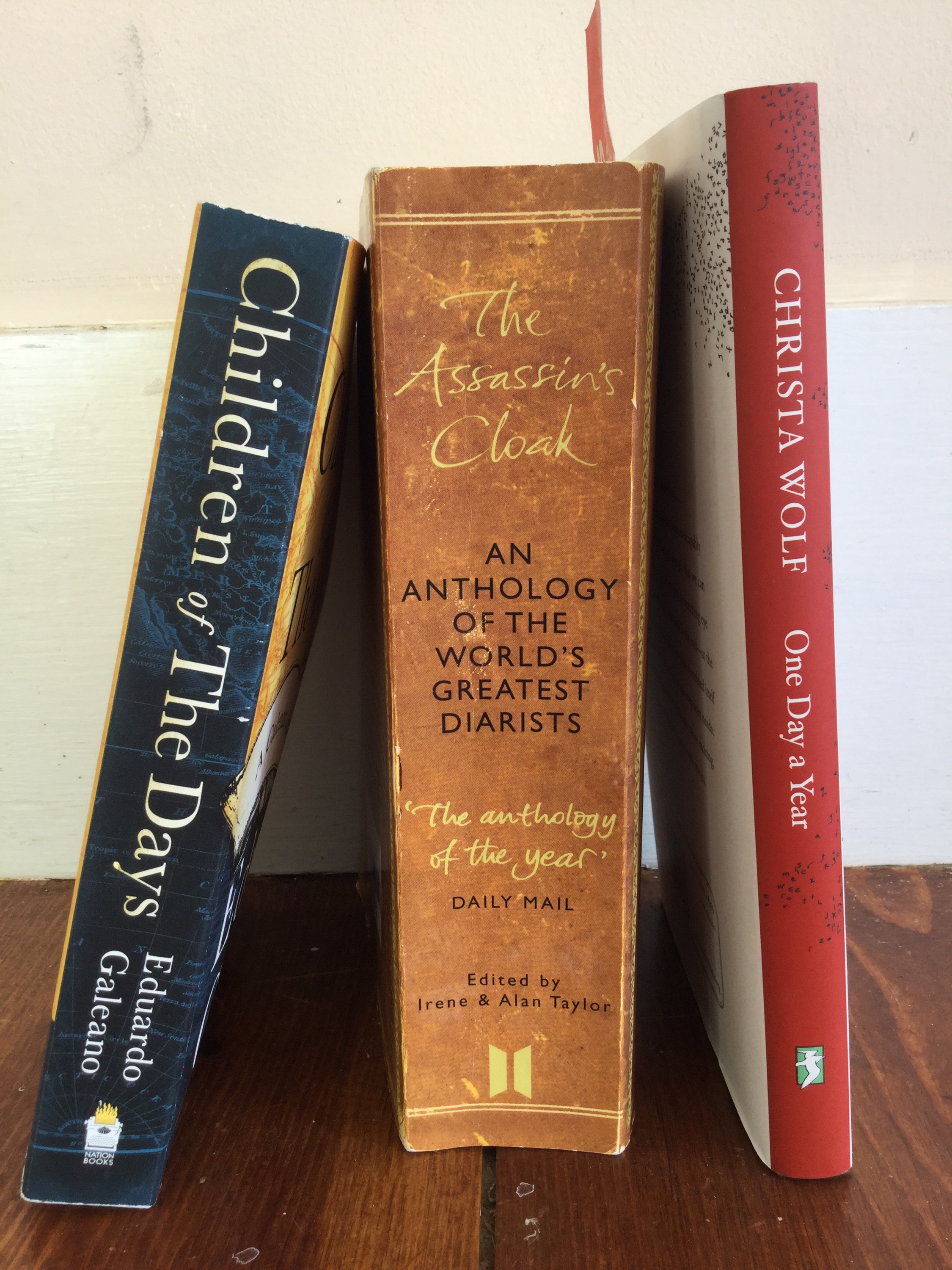
I’ve been thinking a lot since I came across The Assassin’s Cloak, a fantastic anthology of great diary entries categorized by day of the year. On January 5th, for example, Lord Byron wrote about his hangover in 1821, Virginia Woolf recorded a trip to Kingston in 1918, in 1940, Josef Goebbels gloated about the uproar over the Germans’ English radio broadcasts in London and, in 1978, Andy Warhol wondered about Bianca Jagger’s pimples and whether they were caused by depression over Mick.

Less dishy and more surface-skimming is The Children of Days by Eduardo Galeano. Every day highlights an event or person or historical term. May 8th describes the origins of the Tasmanian Devil (which will not endear you to the British Empire) and September 22nd imagines what a car-free day would be like.

Another very different but equally interesting take on time is in Christa Wolf’s One Day a Year. Asked in an interview what she’d done on a specific day, Wolf decided to record what she did on that day (September 27th) every year. For more than fifty years she wrote an entry on that day, and her insights about live in Berlin and international events are fascinating and timeless.