Fictional Simplicity

I would love to conduct a scientific experiment in which one version of my brain read contemporary fiction while another read an old classic, a Jane Austen novel for example, and I could sit back and compare their experiences.

I’m about halfway through Gary Shteyngart’s fantastically funny beautifully written new novel, Our Country Friends. It is entertaining and theoretically immersive and yet I can’t seem to read more than a chapter or two without drifting…(did I pay my credit card bill? I forgot to sign my kid’s sports consent form! Is it cold in here?). Not that this isn’t a fairly common experience in my life, but here’s the strange thing: Last month I re-read Mansfield Park and I sunk into it like a warm bath and came out only when I was relaxed and slightly shriveled.

So I’m wondering if there is a connection. Not in the prose so much as the world it portrays. Shteyngart’s novel is literally of the moment, full of phones, Covid, helicopter parenting and ambitious neurotic people. In Austen, a long walk could be the highlight of the day. News arrives so sporadically that each new snippet can be chewed over for days before the next one arrives.

Think of all the things we need to remember today: Passwords, who to call when the heat doesn’t work. Is it oil? Propane? How to unclog a drain, pay bills, pay taxes. Directions to the dentist, all the various doctor appointments and what your health care plan will cover. Which former republic is Russia planning to invade? What horrible things are the Chinese government doing now, without repercussions? That’s without touching on the latest music, movies, tv shows and whether or not I even subscribe to the service which will allow me to watch them.

Maybe it’s age catching up with me, this desire to downscale the input. My brain is fed up and its way of telling me is to cut me off after a chapter of the latest fiction. It’s telling me that I really should be living in a time when I could spend an entire morning hand-washing the underwear I’ve probably been wearing for days at a time. Gross? Yes. But so much less stressful!


The Jeans Gene

One of the many traits that drifted down from my mom and attached itself to me, barnacle-like, was an interest in fashion. I was not/am not/will almost surely never be fashionable. But that interest is in me, defying my inner eye-rolls and deep attraction to jeans and sweatshirts (a woman I worked with once described my “style” as slobby chic).

My mom’s (enormous) closet was filled with designer suits for day and Pucci dresses for evenings out. She had boxes and trays of accessories specifically purchased to match an outfit. She loved to shop and some of our best bonding happened at Daytons Department Store in Minneapolis, where she tried to convince me to be someone other than me.

I had none of her flair and my interest was once-removed, but that did not stop me from taking a job at Vogue Magazine straight out of college. It was a crappy job and I was a fish laughingly far out of water, but it led to other, slightly less crappy jobs and, finally, to W Magazine and Women’s Wear Daily, where I was finally able to do what I really wanted, which was write (even if most of the writing was about fashion).

When this book, Women in Clothes, came out a few years ago, I was skeptical. I had recently gone freelance and brushed all (most) remnants of the fashion world from the seat of my yoga pants, but the authors (Sheila Heti, Heidi Julavits, Leanne Shapton) were interesting writers and thinkers so the book couldn’t be a deep dive into narcissism.

Well a little bit is, but most of the book is comprised of great stories of women with stories like mine — women who have complicated feelings about clothes. Some see their choices as an extension of their personality, others find solace in specific pieces. Some are vaguely hostile towards the idea of it.

The book itself gave me solace. I thought I was supposed to feel certain things about clothes. It helped me realize how fashion is so often entwined with psychology and how that is not a bad thing; it’s just a thing.

Old Book, New Book

Rodger’s Book Barn, Hillsdale NY

I have not always been such a great reader. For most of my adolescence and (embarrassingly), well into my twenties, I read…non-challenging books. I remember showing one old boyfriend, a real reader, the book I had just bought. His eyes popped at the bright pink cover. “Sweetie Baby Cookie Honey?” he read. I could see him re-evaluating our entire relationship (and in retrospect he should have!)

A few years later, I bought my first hardcover (Spartina, by John Casey, for no reason I can remember now) and it sat in a prominent, GROWN UP, spot on my bookshelf. Then I got a job at Shakespeare & Company and set myself on a new trajectory, one of hoarding and obsession, one in which our house has bookshelves in nearly every room and before an upcoming renovation, I had to ward off a panic attack at the prospect of losing one of the larger shelves.

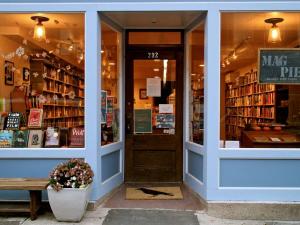
Magpie Books, Catskill NY

As my buying habits continue unabated, I have noticed a shift in how I shop. In the early days of the internet, I was getting constant deliveries (while continuing to patronize my local stores). Lately though, I don’t shop online. I window shop, but somehow the ability to buy anything I want whenever I wanted took the thrill out of it. It reminded me of when my brother used to collect coins and got a manic look in his eye when he stumbled across a new one.

We are lucky enough to have not one but three fantastic used bookstores within a forty-five minute drive of our house. This has always felt like a gluttony of riches, but then it only got better last weekend, when we discovered the seasonal barn next door to one of them.

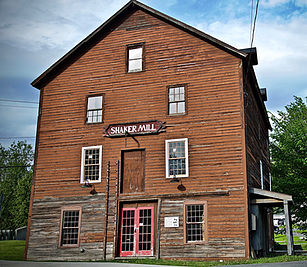
Shaker Mill Books, West Stockbridge, Mass

Shaker Mill Books in West Stockbridge is, in all seasons, a really good store with a great selection of used books and some new. The owner, Eric Wilska, is clearly an obsessive in the best sense of the word. In the winter, the enormous barn next door to the shop is a place to store inventory, but in the summer he opens it up to the public. It’s like nothing else. It’s full of book art (shelves and pillars and furniture constructed entirely from books, a dress made of pages of an encyclopedia) and incredible books you never knew existed (or imagined could exist): magnum size limited edition books which accompanied exhibits, including a David Hockney (signed by Hockney) and a Rolling Stones book full of candid pictures and signed by every member of the band. Wilska himself is extremely friendly and happy to offer background on some of the more surprising features of the store.

I’ve been thinking about why I’m gravitating to used bookstores, and will write about it later. But first I have to do some more research.

Lit Meds

Over the past year I’ve wavered between relief and a sense of survivor’s guilt that COVID has not wreaked havoc in my life. Of course it’s been wrenching to read about so much death and illness and general suffering, but other than my kids being cranky and a bit gloomy and taking over the kitchen like marauding colonizers, everything has been okay. At least I thought.

Then I took a closer look at the books I’ve been reading. I’ve always been a fairly instinctual reader. I drift towards what feels right at the time (unless I’m swept up in the hype over a new book, something I try hard to avoid). Apparently what feels right at this time has been a stack of soothing philosophical books and appreciations of nature and the simple life.

All have been great reads — each snuck up on me with its own slice of wisdom or guidance or appropriate escapism. Here are a few samples:

“Maybe this was what I should have said to the boys: How do you find your own way of looking at things? How do you take off your socially preapproved glasses, so that in every glance at the world around you, you feel a part of the world around you, even saved by your sense of belonging in it — a belonging rooted not in your wearing the same glasses as everyone else, but precisely in having taken them off, in feeling your common solitariness with everyone?” 

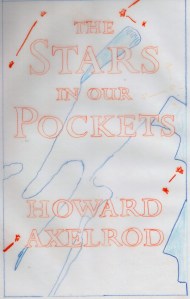
“What I want us to protect isn’t just the distinctive range of consciousness within each of us but also the ability to share that distinctiveness with each other. That’s the only way I’ve found to feel less alone. That’s the deepest way to look at the stars together. To recognize how fundamentally alone each of us is, locked in a separate body and a separate mind, and in that recognition to have the chance to feel all that reaches across that space between us, all the earth-deep connections that are real.” 

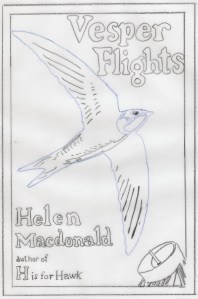
“Watching the flock has brought  home to me how easy it is to react to the idea of masses of refugees with the same visceral apprehension with which we greet a cloud of moving starlings or tumbling geese, to view it as a singular entity, strange and uncontrollable and chaotic. But the crowds coming over the border are people just like us. Perhaps too much like us. We do not want to imagine what it would be to have our familiar places reduced to ruins. In the face of fear, we are all starlings, a group, a flock, made of a million souls seeking safety.” 

“I’ve valued deer for their capacity to surprise and delight me, which is why I’ve resisted learning more about them. The more you know about something, the less it can surprise you. But it’s hard to feel sympathy with a thing whose reality you have chosen to ignore, which makes my attitude not so different from those who would write approvingly of the physics of a dying deer, or how the best thing about a deer collision is how funny it can be.” 

“Science showed him how to see the Cosmos in a grain of sand or the ocean in a woodland pond, a mountain range in Fairhaven Cliff, a glacier in the cobblestones of Walden Pond. Poetry gave him a voice to show the world why this mattered.”

“It takes a man of genius to travel in his own country — in his native village.”

“Hence, emancipation must begin with self-examination: ‘What a man thinks of himself, that it is which determines, or rather indicates, his fate.’ Or, as Saint Augustine wrote in his Confessions: ‘I was held back not be the fetters put on me by someone else, but by the iron bondage of my own will.'”

Two Views of Mrs. Thatcher

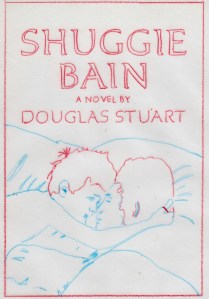
Recently, I caught up with the latest season of The Crown while simultaneously reading Shuggie Bain. Both are excellent and each gives a different perspective (obviously!) on Margaret Thatcher and her deeply reviled economic austerity. In The Crown, as played by Gillian Anderson (whose stiff voice and crooked, purse-slung arm will forever be my vision the Prime Minister), Thatcher is tough but human, a woman interloper in a man’s world. She was, amazingly, sympathetic.

Thatcher never appears directly in Shuggie Bain, but Thatcherism is omnipresent, as it must have been throughout England during that time period. The poverty, the alcoholism, the despair, the crappy housing projects. As she would have said, people need to pull themselves up by their bootstraps. But what if you have no boots?

This is an excellent book to read if you want that bootless experience. The poverty and the despair is palpable — the characters are so well-drawn, the details so immediate — but there is a lightness to the prose. Also, in a book like this it’s so easy to create victims and villains. Douglas Stuart doesn’t do that. Even Shuggie’s father, Shug, is three dimensional and almost sympathetic. Though maybe not in one of my favorite quotes from the book:

“Shug picked up his money belt and kissed her with a forceful tongue. He had to squeeze all the small bones in her hands to get her to release him. She had loved him, and he had needed to break her completely to leave her for good. Agnes Bain was too rare a thing to let someone else love. It wouldn’t do to leave pieces of her for another man to collect and repair later.” 

Day after day after day after…

When you take a step back and think about time as a concept, it’s pretty bizarre. Maybe not so much time as the way we categorize it and feel as if we’ve got a hold of it by chopping it up into manageable pieces (days, months, years).

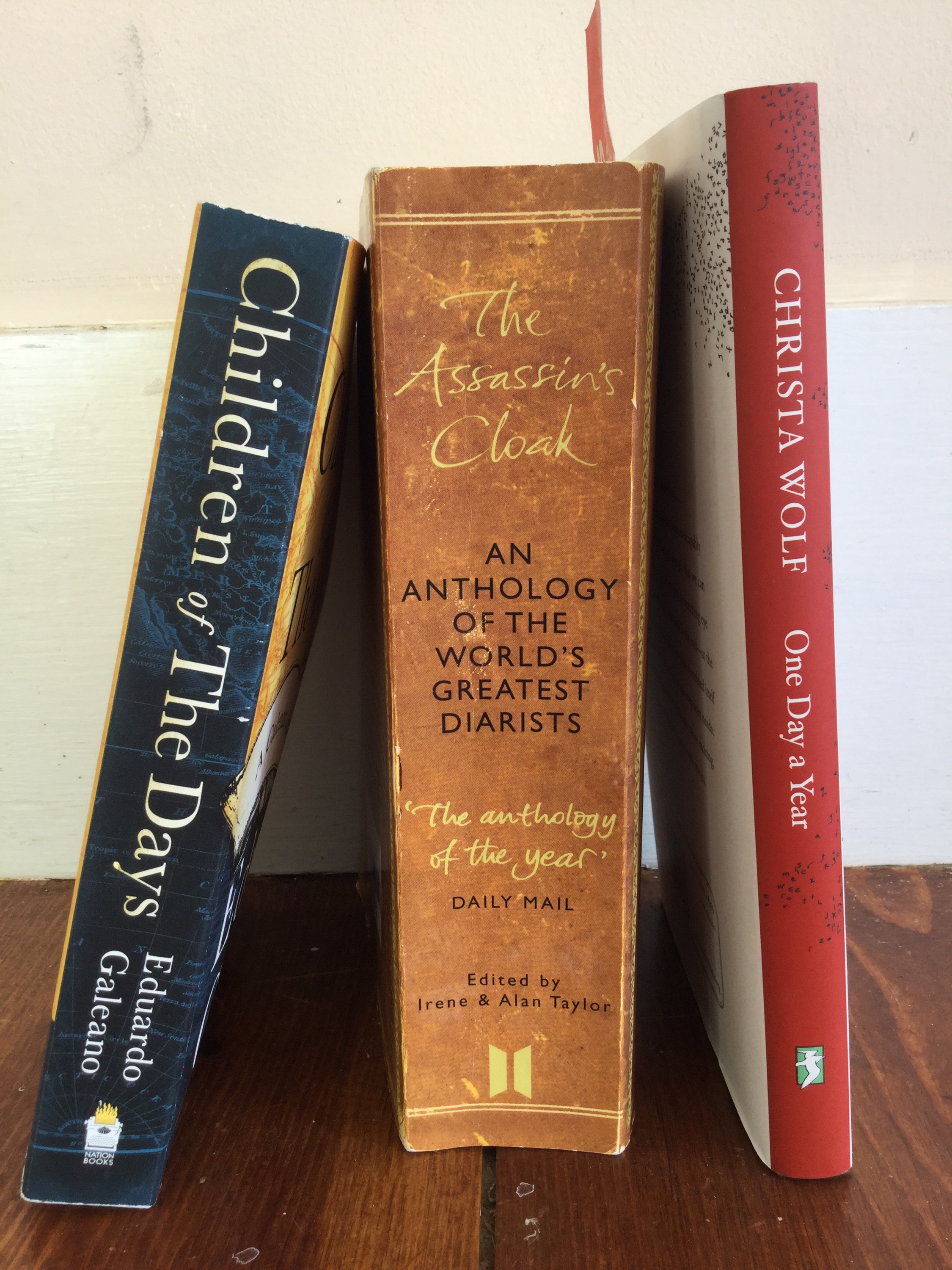
I’ve been thinking a lot since I came across The Assassin’s Cloak, a fantastic anthology of great diary entries categorized by day of the year. On January 5th, for example, Lord Byron wrote about his hangover in 1821, Virginia Woolf recorded a trip to Kingston in 1918, in 1940, Josef Goebbels gloated about the uproar over the Germans’ English radio broadcasts in London and, in 1978, Andy Warhol wondered about Bianca Jagger’s pimples and whether they were caused by depression over Mick.

Less dishy and more surface-skimming is The Children of Days by Eduardo Galeano. Every day highlights an event or person or historical term. May 8th describes the origins of the Tasmanian Devil (which will not endear you to the British Empire) and September 22nd imagines what a car-free day would be like.

Another very different but equally interesting take on time is in Christa Wolf’s One Day a Year. Asked in an interview what she’d done on a specific day, Wolf decided to record what she did on that day (September 27th) every year. For more than fifty years she wrote an entry on that day, and her insights about live in Berlin and international events are fascinating and timeless.